
What is Rete#
AI is reshaping how we learn — how material is created, explained, and practiced. The goal is not speed for its own sake, but more efficient learning: long-term retention, genuine understanding, and study time spent on what actually needs review. Richer context per card, less time on manual authoring, and review that connects what you learn to how it is used — Rete is built for that shift.
Rete (/ˈriːti/) — from the Latin retentio, meaning retention or the act of holding what you have learned in memory — is a collaborative learning platform built on spaced repetition. It follows how the brain works: well-timed review moves knowledge from short-term into long-term memory. Anyone can create a deck, share it, and invite others to contribute — adding cards, fixing errors, refining wording, and keeping content current as a subject evolves.
Three goals shape the platform: a community where learners share study materials and improve them together; a living library of high-quality decks that stays sharp because the people who know each subject keep contributing; and knowledge unlocked from experienced learners — educators, practitioners, and advanced students turning years of expertise into decks anyone can study.
Rete is built for learners who need durable long-term retention — language vocabulary, medical and professional terminology, exam preparation, and ongoing knowledge building — without the friction that often comes with legacy spaced-repetition tools. At its core, you review each item when it is due; intervals grow longer when you remember easily and shorten when you struggle. You focus on answering; Rete handles the scheduling.
What is spaced repetition#
Spaced repetition works through four ideas:
Priority. Put study time where it helps most. Imagine a deck of 2,000 vocabulary words: each review shows the word on the front and the translation on the back; you rate how hard it felt on a scale from 1 to 10. Easy cards are pushed toward the back of the queue — you see them less often — while hard cards stay near the front and return sooner.
Scheduling. The system — not you — decides what is due today. You focus on answering; intervals and queues stay sustainable as the deck grows, instead of becoming an ever-growing backlog you have to plan by hand.
Timing. Recall each card after longer and longer gaps, just as the memory would otherwise fade. Review too soon and you waste effort on what you already know; wait too long and you forget and start over. Well-spaced recall builds durable retention with the least total review time.
Tracking. Every rating becomes history: which cards you know, which ones keep slipping, and how your recall changes over weeks and months. Without that record, priority and timing have nothing to adapt to.
Why We Built Rete#
Rete started with a problem its founder noticed as a graduate student. Many Ph.D. and medical students around him were using spaced-repetition apps for two things — learning a new language, or memorizing difficult medical terminology. The method worked; the tools often did not.
After trying several popular SRS apps, a familiar pattern kept appearing.
The apps themselves were hard to use. Steep learning curves and unintuitive interfaces meant time went into mastering the software, not the material. Decks had to be imported, settings tuned, add-ons configured, and card formats adjusted before a single review session felt worthwhile. What should have been a simple daily habit became a side project in software literacy.
Many products had drifted toward engagement over learning. As apps commercialized, streaks, hearts, notifications, and gamification often mattered more than whether you actually remembered what you studied. Metrics that keep people opening the app are not the same as metrics that build durable memory — yet product design increasingly favored the former.
Shared decks were often poor quality. Material found online was full of typos, outdated facts, cards that tested the wrong thing, weak or missing audio (wrong pronunciation, muffled or robotic speech), and bare word pairs with no example sentences to build context. Good intentions did not make up for sloppy content — and bad cards waste review time just as surely as a bad algorithm.
The problem with rote learning. Rote learning — repeating the same list over and over — is common, but it is not efficient. You spend time re-studying what you already know, forget on an unpredictable schedule, and need far more total hours to hold the same material. Spaced repetition schedules each item when it is about to fade, so you memorize the same content much faster: less wasted review, longer retention, and study time concentrated where it still helps.
Rete was built in response: intuitive design so you can start reviewing without fighting the interface; a learning-first product that optimizes for retention, not engagement theater; and a collaborative platform where decks are created and improved together so quality compounds over time rather than decaying.
Core Features#
Decks and flashcard learning#
Users create and organize decks of flashcards — questions and answers, definitions, terms, example sentences, and other structured formats — and study through spaced review sessions. The point of each card is active recall: the front asks you to retrieve the answer, not reread it. Strong decks keep cards atomic — one clear idea per card — and favor context and production (usage, sentences) over bare recognition. See Key concepts for how decks, facts, fields, and cards fit together.
Collaborative deck building#
Anyone can build a deck, share it, and invite others to contribute. Decks improve over time as contributors add cards, fix inaccuracies, and refine prompts — so quality and accuracy compound rather than decay. Public sets are treated as shared, improvable artifacts rather than static downloads.
Review scheduling#
Scheduling is grounded in the spacing effect and the forgetting curve: retention drops quickly after learning unless review reinforces memory just before it fades. Rete’s algorithms target the gaps left by classical tools such as SM-2 — steep setup, prediction-focused schedules, and review loads that become unsustainable — while keeping the core principle: review what needs review, skip what you already know, and lengthen intervals as memories stabilize.
- Sustainable review load — intervals stay manageable as decks grow, without snowballing daily queues.
- Simple from day one — no add-on ecosystem or configuration rabbit holes.
- Adaptive to how you recall — each card’s next due date reflects your actual performance on that item.
- Desirable difficulty — a bit of struggle before you succeed is useful; intervals aim for that window, not effortless rereads or endless failures.
- Adjustable daily rate — set how many new cards you introduce each day to control your learning pace.
After each review: if you remembered easily, the interval increases; if you struggled or failed, it shortens or resets. Cards that keep failing (leeches) can be surfaced early so you rewrite, split, or suspend them instead of looping forever.
Learning progress tracking#
The platform records study sessions, review completion, and mastery status so learners can see progress over time and keep a steady daily rhythm — small consistent reviews beat weekend cram sessions of hundreds of cards.
AI integration#
AI plugs into spaced repetition at several points — not only to generate cards, but to build, enrich, and maintain decks and to support review itself. Rete emphasizes learning in context: example sentences, usage, and natural phrasing — not isolated word lists.
- Faster card creation — turn notes, textbooks, or messy source material into ready-to-study cards in seconds, not hours.
- Richer context per card — AI can auto-generate examples, mnemonics, or alternate phrasings so a single fact is reinforced from multiple angles.
- Better source material, less manual curation — auto-summarization and card generation from dense material means higher-quality decks with less authoring effort.
- Quality and imports — flag vague, ambiguous, or duplicate cards; normalize messy imported decks into a clean, consistent structure.
- Periodic LLM quality checks — the most advanced large language models periodically audit deck content for translation accuracy and audio quality, so shared decks stay reliable as they grow.
- Adaptive review — personalize scheduling from your review history, surface likely leeches early, and accept semantically correct free-text answers — not just exact string matches.
See AI-Assisted Deck Quality for how Rete uses AI to audit published decks today.
Intuitive Design, Built for Learning#
Intuitive design is a core part of Rete's product philosophy. A learning tool should not be a separate skill you have to master — the interface should make the next step obvious. The platform uses a clean, modern layout with clear paths for decks, review, and progress, so you are not lost in nested menus or complex settings.
This works alongside Rete's other platform strengths:
- Out of the box — no add-ons or lengthy setup; open a deck and start reviewing.
- Multilingual support — interface and content in multiple languages, so you can learn in the language you know best.
- Built for daily habit — scheduling and interface are designed for sustainable daily review, not one-off cramming or ever-growing backlogs.
The goal is for review itself to be the focus, not learning how to use the software.
The Science Behind Rete#
The Spacing Effect#
The spacing effect is one of the most replicated findings in cognitive psychology: if you study the same material in two sessions, you remember more when those sessions are separated in time than when they are back-to-back. Hermann Ebbinghaus demonstrated this in the 1880s; later researchers have confirmed it for vocabulary, facts, and skills across many domains.
Why does spacing work? One leading explanation is that each time you successfully recall something after a delay, you strengthen the long-term trace. Forgetting a little (but not completely) before reviewing seems to make the memory more durable. Cramming, by contrast, produces strong short-term memory that fades quickly.
The Forgetting Curve and Spaced Repetition#
Ebbinghaus also described the forgetting curve: after learning, retention drops quickly at first and then levels off. Without review, most of what we "learn" in a single session is lost within days — retention follows that curve steadily downward.
Spaced repetition changes this pattern. Each time you review at the right moment, retention resets and memory becomes more stable — the curve flattens instead of sliding toward ~20%.
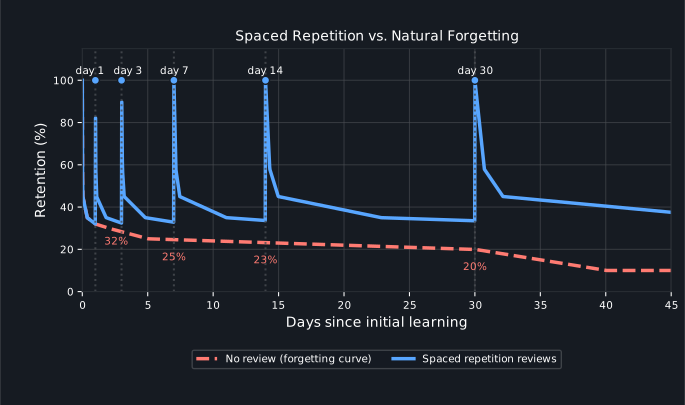
The chart compares two paths over 45 days. The dashed line shows no review — a steady slide down the forgetting curve. The solid line shows spaced repetition: brief drops before each scheduled review, then retention bounces back to ~100% while intervals grow longer (1, 3, 7, 14, 30 days). Each successful review strengthens the memory trace, so forgetting slows over time.
Spaced repetition uses this pattern. By reviewing at or just before the point where you would forget, you extend the interval each time. Easy items move to longer intervals (days, weeks, months); hard items stay on shorter intervals until they stabilize. The result is that you spend most of your time on items that actually need review, not on ones you already know well.
How Rete's Algorithm Works#
Classical spaced-repetition algorithms like SM-2 automated scheduling, but they still leave familiar problems unsolved: review backlogs that snowball into hundreds of cards per day, steep setup before your first productive session, and schedules tuned for prediction accuracy rather than sustainable daily study.
Rete uses a novel scheduling algorithm built on the same spacing science, designed specifically around those gaps:
- Sustainable review load — intervals are managed so decks stay studyable as they grow, without the compounding backlog that pushes people off legacy SRS apps.
- Simple from day one — no add-ons, no configuration rabbit holes; you open a deck and start reviewing.
- Adaptive to how you recall — after each review, the next due date reflects how well you remembered the item, not a one-size-fits-all formula.
- Adjustable daily rate — set how many new cards you introduce each day to control your learning pace.
Each card has a due date. You focus on answering; Rete handles the scheduling.
Why It Matters in Practice#
Spaced repetition is not a trick; it is a way of aligning study with how memory actually works. It reduces total study time because you stop over-reviewing material you already know and focus on what is slipping.
It also reduces stress: instead of last-minute cramming, you do a steady amount of review each day, and the system keeps track of what is due. Rete is designed to replace common failure modes in both traditional study and legacy SRS tools: content forgotten soon after cramming, disorganized or unsustainable schedules, time lost configuring tools, shared decks that are inaccurate or outdated, and repetitive review of items already mastered.
Instead of wasting time scrolling TikTok, Instagram, or YouTube, do a short review session. A few minutes of due cards leaves you with something remembered — not another empty scroll.
Whether you are learning a language, preparing for exams, or building a knowledge base of facts and concepts, spacing your reviews makes the effort more efficient and the results longer-lasting.
What Rete Is Not#
Rete is not a replacement for education. Classroom instruction, discussion, hands-on practice, and guidance from teachers still matter — spaced repetition cannot substitute for understanding built through teaching, feedback, and real engagement with a subject.
Treat Rete as a supplementary tool: it helps you retain what you have already learned, so less time is lost to re-learning forgotten material and more time can go toward going deeper. Used alongside classes, textbooks, and structured study, it makes your learning journey more efficient — not a way to skip the journey itself.
Who Rete Is For#
- Students at all levels who want to improve learning efficiency through spaced, systematic review
- Language teachers and learners building and sharing vocabulary and expressions for long-term use
- Exam and certification candidates who need systematic review rather than cramming
- Self-directed learners maintaining a personal knowledge base over months or years
- Educators who want to publish decks shaped by classroom experience — where each card tests one idea, wording is clear, and sequencing builds from foundations outward
- Ph.D. and medical students and other advanced learners memorizing dense terminology or concepts
Typical Use Cases#
- Language vocabulary and expressions (e.g. English, Japanese, and other L2 study)
- Medical, legal, finance, programming, and other professional terminology
- Academic and certification exam review
- Personal reading notes and long-term knowledge management
- Community-maintained decks that stay accurate as fields update
A Note to Educators#
The quality of a spaced-repetition deck matters as much as the algorithm behind it. A well-structured deck — where each card tests exactly one idea, uses clear and unambiguous wording, and sequences from foundational concepts outward — can compress years of rote study into months of focused review.
That kind of quality comes from people who have spent years in the classroom: knowing which misconceptions trip students up, which distinctions are worth drilling, and how to phrase a prompt so the right memory is retrieved rather than a superficial one.
We invite educators to bring that expertise to Rete. Whether you teach a language, a science, history, or a professional subject, the decks you build carry something no automated generator can replicate — the judgment of someone who has watched real learners struggle and succeed with this material. High-quality educator-built decks benefit not just your own students, but every learner on the platform who studies the same subject.
AI-Assisted Deck Quality#
Educator judgment sets the standard; AI helps maintain it at scale. Rete uses an AI review pipeline that runs continuously across published decks, surfacing issues that are easy to miss during manual authoring:
- Accuracy checks — flagging factual claims that conflict with up-to-date sources, so decks stay correct as knowledge evolves.
- Clarity rewrites — identifying prompts with ambiguous wording or double-barrelled questions, where a learner could produce a valid answer without having learned the intended concept.
- Redundancy detection — finding cards that test the same underlying fact in slightly different words, which inflates review load without adding retention value.
- Difficulty calibration — comparing a card's observed failure rate against its position in the deck's stated difficulty sequence, catching items that are harder or easier than expected.
- Coverage gaps — cross-referencing the deck's topic scope against an outline of the subject, highlighting concepts the deck may be missing entirely.
Suggested edits are always reviewed before they go live. The educator stays in control; the AI handles the auditing work that would otherwise require reviewing every card by hand. The result is a deck that improves incrementally over time rather than drifting toward staleness.
For the full narrative review — including recent meta-analyses (2024–2026), neural mechanisms, scheduling algorithms, and adoption barriers — see Our research.
Summary#
Rete is a collaborative spaced-repetition platform: simple to start, grounded in retention science, and built so decks and schedules stay usable over the long term. Flashcards, adaptive scheduling, shared improvement, and AI-assisted quality checks work together so learning is efficient, steady, and cumulative — not a side project in software configuration or a race against forgotten shared content.